
Add MobiGyaan as a preferred source on Google
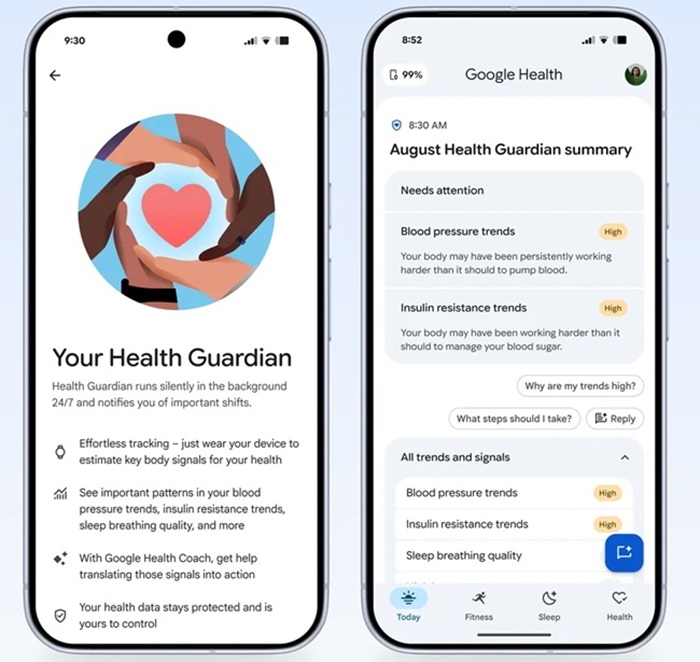
Google has announced Health Guardian, a new suite of health and safety features coming to the Google Health app for qualified Pixel Watch devices and Fitbit Air. The system is designed to monitor subtle physiological changes continuously in the background and surface longer-term trends through monthly summaries, along with alerts when certain changes may require attention.
Google Health Guardian is part of Google’s broader push toward continuous, personalized health guidance through wearables and the Google Health app. Google says the system is designed to turn sensor data into understandable insights rather than simply presenting users with raw measurements.

Google Health Guardian Features
Health Guardian currently includes four major features:
- Insulin Resistance Trends: Analyzes physiological data collected over multiple weeks to identify changes associated with metabolic health, without requiring a blood sample. Google says the feature can help users recognize trends that may encourage changes in areas such as nutrition, sleep, and physical activity.
- Blood Pressure Trends: Uses pulse and motion patterns collected over time to estimate blood pressure trends without requiring a traditional cuff or manual calibration. Google recommends confirming concerning trends using a home blood pressure monitor or discussing them with a healthcare professional.
- Sleep Breathing Quality Trends: Monitors changes in breathing during sleep and provides a daily indication of how much sleep was spent with optimal breathing. Monthly summaries can highlight longer-term changes in breathing patterns.
- Breathing Emergency Detection: An opt-in safety feature for Pixel Watch users in select European countries. It is designed to detect dangerously low blood oxygen levels and can automatically contact emergency services, and emergency contacts where applicable, if the wearer becomes unresponsive.
Google emphasizes that these features are intended to provide health and wellness information and should not be treated as a replacement for professional medical diagnosis or care.
AI-Powered Health Insights
Google is using AI models trained on large-scale sensor datasets to identify physiological patterns. According to the company, the models were developed using data from millions of opted-in users and billions of minutes of everyday sensor data, allowing them to account for factors such as incomplete or missing measurements.
For Insulin Resistance Trends, Google says its underlying sensor foundation model was pretrained using more than one trillion minutes of data from 5 million opted-in users. The model was evaluated against standard clinical blood tests, with the related research published in Nature.
The Blood Pressure Trends feature uses Google’s WavesFM foundation model, which was trained on billions of minutes of heart and movement data and evaluated across diverse populations as part of Fitbit’s hypertension research.
Monthly Health Summaries & Google Health Coach
Rather than requiring users to constantly monitor individual metrics, Health Guardian will surface notable changes through monthly summaries inside the Google Health app. Users may also receive notifications when the system identifies a change that warrants attention.
Google’s Health Coach, powered by Gemini, is designed to help users understand these trends and translate the information into practical wellness guidance. The Google Health app already brings together health information from compatible wearables and other connected health sources, with users retaining control over what data they save and share.
Availability
Google says Health Guardian is coming soon to the Google Health app for qualified Pixel Watch devices and Fitbit Air.
- Qualified Pixel Watches and Fitbit Air: Health Guardian features
- Pixel Watch in select European countries: Breathing Emergency Detection
- Google Health app: Central hub for Health Guardian insights and summaries
Google has not provided a specific rollout date for all Health Guardian features yet.

