
Add MobiGyaan as a preferred source on Google
JEDEC Solid State Technology Association has previewed its next-generation DDR6 DRAM standard, which is currently under development. Designed to address the growing memory requirements of AI, cloud computing, data centers, servers, and client computing, DDR6 will introduce changes to memory architecture, data rates, bandwidth, capacity, power efficiency, and reliability compared with DDR5.
The upcoming standard is expected to deliver higher memory bandwidth through faster data rates and a wider data bus, alongside architectural changes designed to improve memory access and data movement.
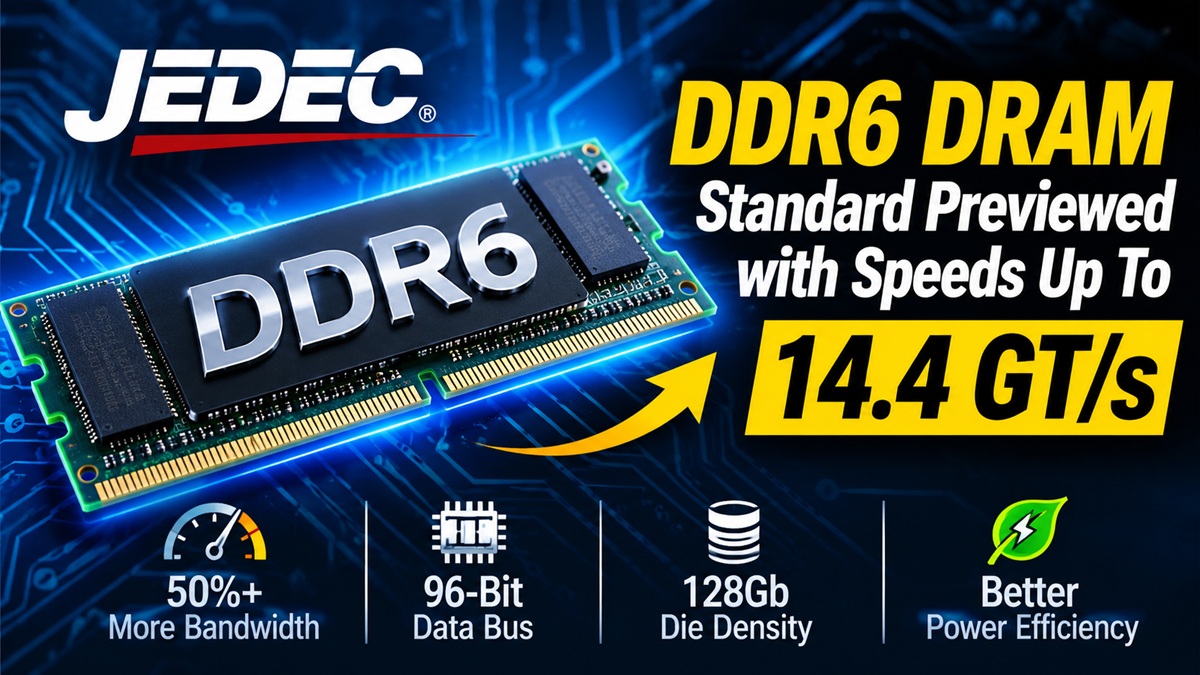
DDR6 Performance & Memory Architecture
DDR6 RDIMMs will initially support data rates of 12.8 GT/s, compared with DDR5’s 9.2 GT/s. The roadmap extends to 14.4 GT/s and beyond.
According to JEDEC, combining higher data rates with a wider data bus is expected to increase bandwidth by more than 50% at introduction. Further bandwidth improvements are anticipated as data rates increase. However, JEDEC clarified that this bandwidth target does not translate into an equivalent improvement in application performance.
The planned architectural changes include:
- Data Bus Width: Increased from 64 DQ to 96 DQ, representing a 50% increase
- Pseudo-Channel Architecture: Organizes memory access into pseudo-channels to support higher bandwidth per DRAM package, greater configuration flexibility for system reliability, and more efficient data movement
- Bank Availability: Doubles the bank count, while improved refresh increases data bus efficiency to support higher speed grades and memory capacities
DDR6 Capacity & Reliability
DDR6 will support DRAM die densities of up to 128Gb. Die-stacking optimizations within DDR6 packages are also intended to increase memory density while retaining the same package footprint.
JEDEC has also outlined a change in module dimensions. DDR6 modules are planned to measure 74 mm in length, compared with 133 mm for DDR5 modules. The narrower footprint is intended to help accommodate higher system memory density.
For reliability, DDR6 will support multiple system error-correcting code (ECC) implementations. This will allow system designers to balance cost, power consumption, and reliability based on their requirements.
The interface is also being optimized for high-capacity memory modules, with configurations targeting general-purpose computing, AI inferencing, and agentic AI workloads that require greater memory capacity and performance close to the CPU.
DDR6 Power Efficiency & Form Factors
DDR6 aims to improve performance-per-watt compared with DDR5 through a transition to VSS-terminated I/O and low-power modes focused on data center requirements.
JEDEC is defining the standard across multiple form factors to address different system requirements. The planned form factors potentially include:
- RDIMM: Registered DIMM
- UDIMM: Unbuffered DIMM
- CAMM: Compression Attached Memory Module
These form factors are intended to serve different applications while balancing reliability, performance, power consumption, and cost.
Speaking on the development, Christopher Cox, Chair of the JC-42 Committee for Solid State Memories, said, “As AI and data-intensive workloads continue to drive system requirements higher, DDR6 is being developed to deliver significant advances in memory bandwidth, capacity, and reliability. The collaboration of JEDEC member companies is helping establish a next-generation memory standard that balances performance, power efficiency, and scalability across a wide range of computing applications.”
Commenting on the development, Mian Quddus, Chairman of the JEDEC Board of Directors, said, “JEDEC members gain early access to pre-publication proposals and insights into active projects such as DDR6. We welcome interested companies worldwide to join JEDEC today to help shape the future of standards for this dynamic industry.”
DDR6 Standard Development & Availability
JEDEC is continuing work on the DDR6 standard, with specifications and supported configurations still subject to change during the development and approval process.
The organization has not announced a timeline for finalizing the standard. Consequently, the outlined data rates, architecture, capacity, and form factors remain part of the ongoing development plans.

