

Add MobiGyaan as a preferred source on GoogleMeta has introduced Muse Wonder and Muse Wonder Full, two new AI models designed for personal and professional agentic tasks. Building on the company’s Muse Spark model and its work on pretraining and reinforcement learning, the new models aim to handle complex tasks involving coding, specialised knowledge, long-running projects, and personal assistance.
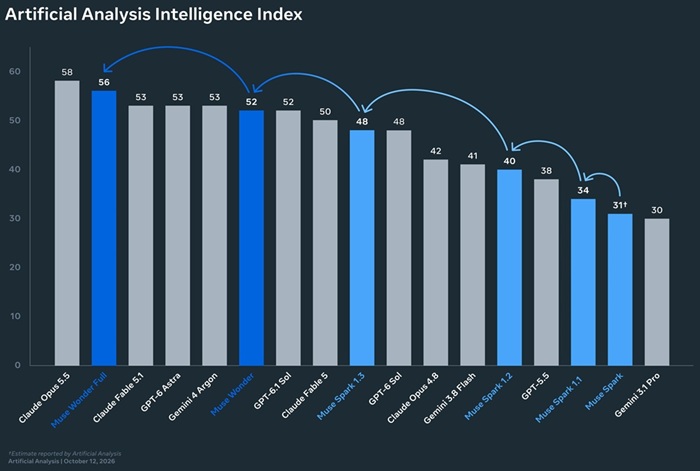
Meta describes the Muse Wonder series as its most capable models to date. The launch follows a broader overhaul of the company’s AI efforts that began 14 months ago, with Meta moving from rebuilding its AI foundations towards developing models capable of handling more complex tasks. Both models were trained at Meta’s gigawatt-scale Prometheus data centre.

Muse Wonder & Muse Wonder Full | Advanced Agentic Capabilities
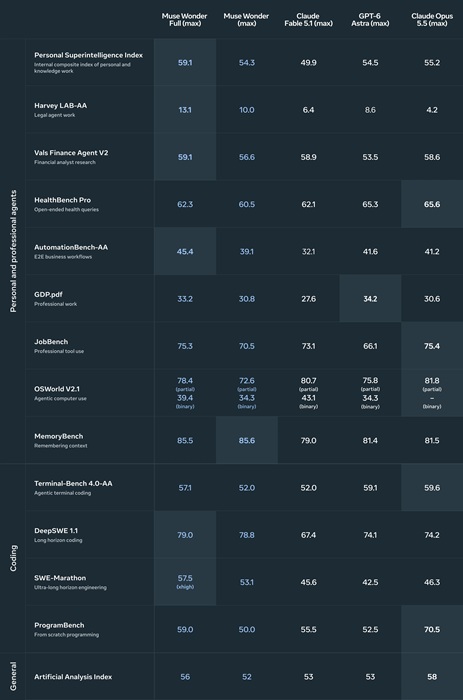
The Muse Wonder series builds on Meta’s approach to scaling AI models through pretraining and reinforcement learning. The company has evaluated the models across several areas, including personal and professional agents, memory, coding, and general capabilities, comparing their performance with other frontier AI models.
Meta’s focus is on models that can do more than respond to individual prompts. They are designed to work through multi-step tasks, manage requirements, adapt when something goes wrong, and make progress towards a goal over time.
Domain Expertise In Law, Finance, and Health | Improved Coding Capabilities
Muse Wonder and Muse Wonder Full are designed to handle tasks involving specialised knowledge in areas such as law, finance, and health. Meta’s evaluations include Harvey’s Legal Agent Benchmark (LAB), which assesses whether AI models can use source documents and follow detailed instructions to produce legal work products.
For coding, Meta focused on tasks that require models to track requirements, modify multiple parts of a codebase, and test and revise their work. The models were trained on diverse, long-running tasks intended to support development ranging from small applications to more complex software projects.
This approach targets coding workflows where an AI model must maintain context across multiple steps instead of simply generating a code snippet in response to a single request.
Active Memory & Active Focus | Better Context Retention & Task Execution
Meta has introduced two capabilities intended to help its models retain relevant information and work towards goals over extended periods.
- Active Memory: Retains important context across conversations and retrieves relevant details when required for a task.
- Active Focus: Helps the models continue working towards a goal by exploring alternative approaches, overcoming obstacles, recovering from errors, and adapting to new information. The models can also ask for clarification and check with users before taking important actions.
Meta evaluates these capabilities using FocusBench for focus and SWE-Marathon for sustained execution on long-running software projects. Together, they are intended to help AI agents maintain progress when tasks require multiple decisions, corrections, and follow-up actions.
Generalization To Unfamiliar Tasks | Stronger Base Models
Meta also evaluated how well Muse Wonder models perform on tasks that were not specifically targeted during post-training. This addresses the issue of “benchmaxxing”, where models are optimised for selected benchmarks, potentially making benchmark scores an incomplete measure of their broader capabilities.
The company compared Muse Spark 1.3 and Muse Wonder Full at different levels of test-time compute, with each evaluation point representing a different amount of reasoning effort. The assessment measured both in-distribution performance on tasks targeted during post-training and out-of-distribution performance on tasks that were not targeted.
According to Meta, both models improve similarly on unfamiliar tasks as test-time compute increases. However, Muse Wonder Full performs better on out-of-distribution tasks than would be predicted from Muse Spark 1.3’s in-distribution performance.
Meta attributes this difference to the larger and stronger base models behind the Muse Wonder series. The company believes that stronger base models allow improvements from post-training to transfer more effectively to unfamiliar tasks. This could be important for personal AI agents, which need to manage combinations of goals, tools, and constraints that cannot all be anticipated during training.
Safety & Privacy | Stronger Protections Against Misuse
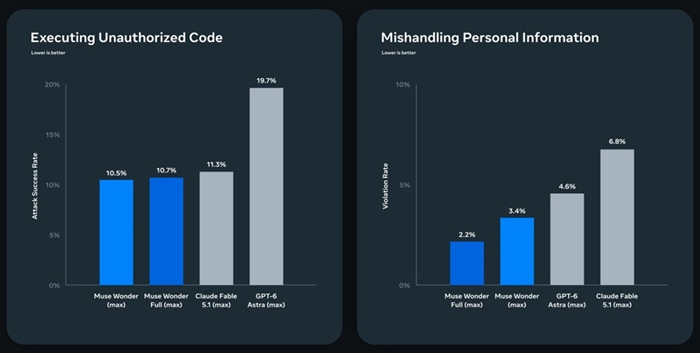
Since personal AI agents may access sensitive information such as messages, calendars, and private documents, Meta said it trained the Muse Wonder family to protect private information, resist misuse, and support defensive security work.
The models are trained to avoid sharing private information without permission, refuse requests for harmful activities, resist adversarial instructions, and help developers and security teams identify vulnerabilities in their own code and strengthen their systems.
Meta also said the models have its strongest safeguards to date against chemical, biological, radiological, and nuclear (CBRN) misuse, as well as cyber misuse. At the same time, the company aims to preserve cybersecurity capabilities for defensive applications.
The Muse Wonder family is developed under the standards outlined in Meta’s Superintelligence Scaling Framework, which governs how the company trains, evaluates, and releases its most capable AI models. Meta describes Muse Wonder as its most aligned model to date and said a full report with additional safety evaluations will be available soon.
Muse Wonder & Muse Wonder Full Availability
Muse Wonder is available to developers and builders through the Meta Model API and Muse Code. Muse Wonder Full, meanwhile, is available to Muse Code subscribers.
Meta also plans to expand Muse Wonder to more experiences in its Muse app, starting with subscribers. The model is expected to support artifact generation and workflows that require more intelligence. Meta also plans to use it as a foundation for developing specialised models for future Muse experiences.
With the Muse Wonder series, Meta is expanding its focus on AI systems that can retain context, handle complex workflows, and make progress on tasks over time, rather than being limited to individual conversational responses.