

Add MobiGyaan as a preferred source on Google
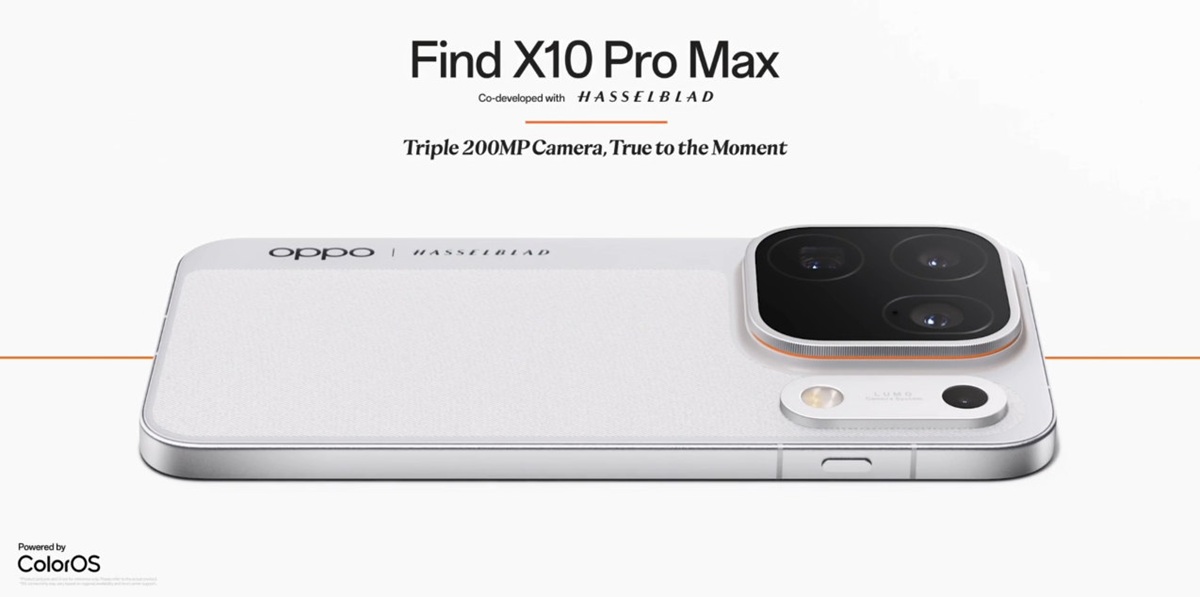
OPPO India has detailed the camera systems and imaging technologies of its upcoming Find X10 Series ahead of its India launch on 22nd October 2026. The lineup includes the OPPO Find X10 Pro Max and the standard OPPO Find X10, featuring high-resolution rear cameras developed in partnership with Hasselblad and the company’s LUMO True Image Engine for image processing. The Find X10 Pro Max features a triple 200 MP rear camera setup, while the standard Find X10 combines a 200 MP main camera, a 200 MP telephoto camera, and a 50 MP ultra-wide camera.
OPPO Find X10 Series Camera Specifications
The OPPO Find X10 Pro Max features three 200 MP rear cameras, covering the main, ultra-wide, and telephoto focal lengths. The main camera uses a 1/1.3-inch Samsung ISOCELL HPC sensor with a 24 mm equivalent focal length, f/1.5 aperture, and optical image stabilization (OIS).
The ultra-wide camera uses a 1/1.56-inch ISOCELL HP5 sensor with a 13 mm focal length, f/2.2 aperture, and autofocus. The telephoto camera also uses a 1/1.56-inch ISOCELL HP5 sensor, with a 70 mm focal length, f/2.1 aperture, and OIS.
The standard OPPO Find X10 features a 200 MP main camera with a 1/1.4-inch ISOCELL HPE sensor, 23 mm focal length, f/1.6 aperture, and OIS. Its camera system also includes a 50 MP ultra-wide camera and a 200 MP telephoto camera with OIS.
Both smartphones feature a 50 MP front camera with an f/2.0 aperture and a 100-degree field of view, along with autofocus.
DeepPix Sensor Architecture and Dynamic Range
The Find X10 Pro Max introduces OPPO’s DeepPix sensor architecture for its 1/1.3-inch primary camera. The technology incorporates three hardware modifications: Front Deep Trench Isolation (FDTI), Dual Vertical Transfer Gate (Dual VTG), and Expanded Floating Diffusion (FD).
According to OPPO, these changes increase the sensor’s full-well capacity by 60% compared with the previous generation. The company also claims up to 17 stops of single-frame dynamic range and native single-frame 16-bit HDR capture.
OPPO says the 17-stop dynamic range operates during standard 4K 60fps video recording without requiring manual activation.
LUMO True Image Engine
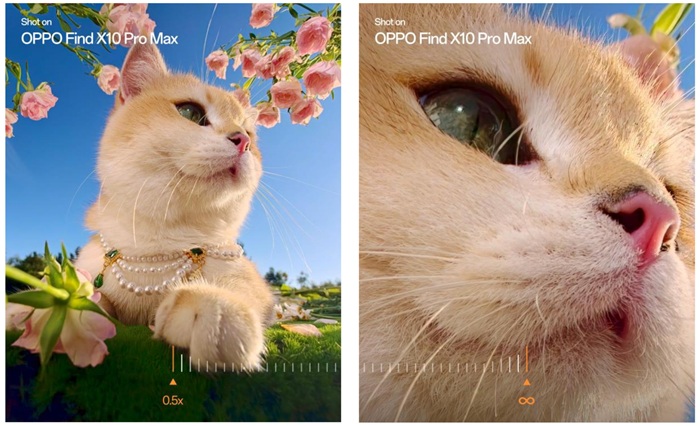
The Find X10 Series uses the LUMO True Image Engine, which manages image capture, color mapping, and tone reproduction through three processing components.

LUMO Hyper Pixel Engine
The Hyper Pixel Engine produces approximately 25 MP images during standard shooting across focal lengths ranging from ultra-wide to 9.9x zoom. In low-light conditions, the system switches to 12 MP pixel-binned output.
For high-resolution photography, the engine supports 50 MP capture across five focal lengths through Hasselblad Hi-Res Mode, as well as native 200 MP multi-frame fusion on supported sensors. OPPO says its processing prioritizes natural skin textures and micro-contrast over aggressive sharpening or smoothing.

LUMO True Color Engine
The True Color Engine combines a 24-channel multispectral sensor with Dual Conversion Gain HDR (DCG-HDR) and Dynamic Action Gain (DAG). OPPO claims up to 15 EV of spectral dynamic range.
The system also incorporates Hasselblad color science for white balance, saturation, and skin-tone reproduction in mixed lighting conditions.

LUMO Natural Tone Engine
The Natural Tone Engine derives tone-curve parameters from Hasselblad Master Mode. According to OPPO, this approach is designed to manage shadow detail and local tone mapping.

Video Recording and Post-Production Features
OPPO has detailed video recording capabilities across the Find X10 Series, including high-frame-rate recording, professional color workflows, and full-sensor video capture.
The OPPO Find X10 Pro Max supports 4K video recording at 60fps and 120fps, along with 8K recording at 30fps, across all three rear cameras.
The standard OPPO Find X10 supports 4K 60fps recording across its three rear cameras. Its main and telephoto cameras additionally support 4K 120fps recording with Dolby Vision and 8K recording at 30fps.
Both models support the O-Log2 flat gamma profile for 4K 60fps, 4K 120fps, and 8K 30fps workflows. The camera interface also includes real-time LUT previews and the ability to apply LUTs directly to recorded footage.
The series introduces Open Gate Capture, which records video using the full sensor in a 4:3 aspect ratio. OPPO says this retains 25% more vertical capture area along the long edge and 66% along the short edge compared with conventional 16:9 recording with electronic image stabilization enabled. The footage can then be cropped into horizontal 16:9 or vertical 9:16 formats.
LUMO Lab: Camera Tuning for India
OPPO has also highlighted its LUMO Lab initiative, through which engineers and Indian commercial creators evaluate camera performance under regional shooting conditions.
Previous testing phases covered high-contrast festive lighting, regional architectural colors, diverse skin tones, and textured textiles.
The fourth testing phase took place in Kerala, where OPPO’s global imaging executives and local photographers evaluated fast movement and changing lighting conditions during Kathakali, Kalaripayattu, and nighttime Theyyam performances. OPPO says insights from these sessions informed the exposure metering, color LUTs, and HDR curves used in the production devices.
OPPO Find X10 Series India Launch: 22nd October 2026
The OPPO Find X10 Series, including the Find X10 Pro Max and Find X10, is scheduled to launch in India on 22nd October 2026. OPPO has detailed the camera hardware and imaging features ahead of the launch, while pricing and other specifications have not been provided in the information released so far.