
Add MobiGyaan as a preferred source on GoogleOpenAI and Microsoft have announced an amended partnership agreement, introducing greater flexibility in how AI products are deployed and scaled. The updated deal reflects the rapid pace of AI innovation, with both companies aiming to simplify collaboration while expanding global AI delivery.

Key Changes in the Agreement
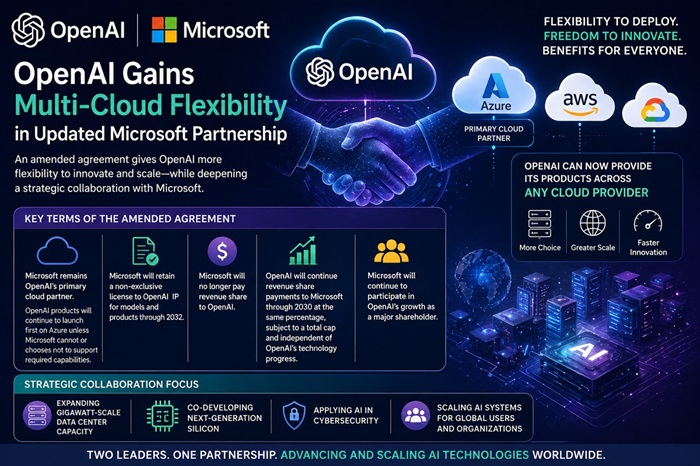
The revised structure introduces multi-cloud flexibility while maintaining Microsoft’s central role.
Core Terms:
- Microsoft remains OpenAI’s primary cloud partner
- OpenAI products will launch first on Azure, unless unsupported
- OpenAI gains the ability to deploy across multiple cloud providers
Licensing and Financial Updates:
- Microsoft retains a non-exclusive license to OpenAI IP until 2032
- Microsoft will no longer pay revenue share to OpenAI
- OpenAI will continue revenue sharing with Microsoft until 2030, subject to a cap
- Microsoft remains a major shareholder in OpenAI
What Multi-Cloud Access Means
The biggest shift is OpenAI’s ability to operate beyond a single cloud ecosystem.
Impact:
- Greater deployment flexibility
- Reduced dependency on a single provider
- Ability to scale AI services faster and globally
- Improved resilience and performance optimization
This aligns with broader industry trends toward multi-cloud and hybrid infrastructure strategies.
Despite structural changes, the partnership remains deeply integrated. Key focus areas include expansion of gigawatt-scale data centers, co-development of next-generation AI chips, application of AI in cybersecurity, and scaling AI systems for enterprise and global users. Both companies continue to collaborate on core AI infrastructure and innovation pipelines.
The updated agreement highlights a shift in how major AI players are structuring partnerships:
- Moving from exclusive dependencies → flexible ecosystems
- Balancing competition and collaboration
- Scaling infrastructure to meet explosive AI demand
This evolution reflects the growing importance of compute access and distribution strategy in AI leadership.

