
Add MobiGyaan as a preferred source on GoogleOPPO has announced ColorOS 17, the latest version of its mobile operating system, bringing a redesigned interface, system-level performance improvements, expanded AI capabilities, and enhanced privacy and security features. The update introduces the new Living Flow Design, a Unified Rendering Architecture, and an upgraded Laminar Flow Engine, alongside AI tools designed to automate tasks, edit photos, organize personal information, and provide contextual assistance.
ColorOS 17 will debut on the upcoming OPPO Find X10 Series, followed by a phased global rollout to additional OPPO devices. The company has highlighted improvements in interface responsiveness, background app retention, AI-powered workflows, and long-term smoothness as key aspects of the new software.
ColorOS 17 has also been announced for OnePlus devices in India, marking the brand’s transition from OxygenOS to ColorOS, with the rollout scheduled to begin on 29th October 2026, starting with the OnePlus 15 and OnePlus Pad 4.
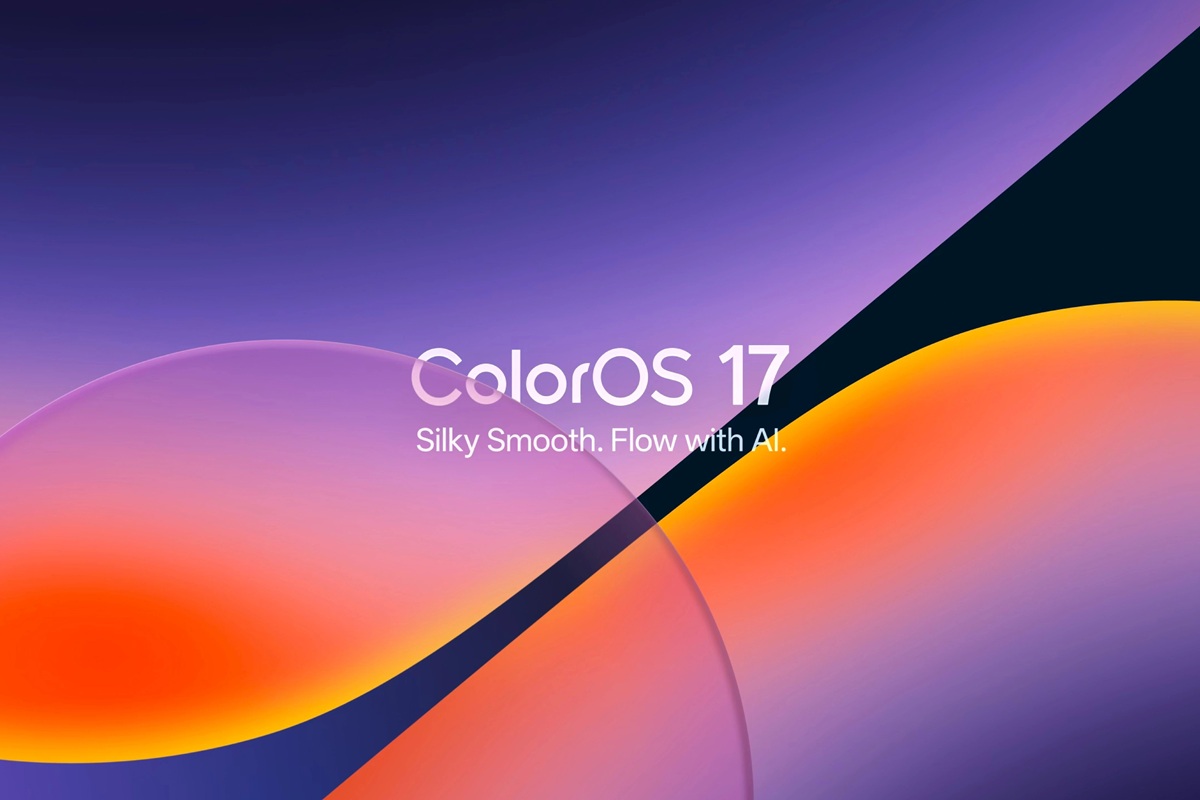
Living Flow Design | Luminous Effect | Fluid Motion | Flexible Feedback
ColorOS 17 introduces Living Flow Design, following Parallel Animation in ColorOS 15 and Seamless Animation in ColorOS 16. The new interface is built around three elements: Luminous Effect, Fluid Motion, and Flexible Feedback.
Luminous Effect introduces softer, translucent visuals with layered depth and lighting effects that respond to touch. Fluid Motion focuses on seamless transitions, allowing interface elements to move, merge, and transform between states without abrupt changes. Flexible Feedback adds responsive animations to buttons, toolbars, and other controls, which compress, stretch, and rebound when tapped.
These changes extend across app transitions, Fluid Cloud, notification panels, and music controls. The lock screen clock transitions into the home screen, while interactive elements respond dynamically to taps and drags. The music progress bar also incorporates pulsing light effects that react to track changes and touch input.
Unified Rendering Architecture | Up to 30% Lower Rendering Load
ColorOS 17 uses a Unified Rendering Architecture built on the refreshed Luminous Rendering Engine. The architecture combines previously separate rendering processes into a unified pipeline, reducing redundant operations while supporting richer visual effects and smoother transitions.
According to OPPO, the new architecture reduces rendering loads by up to 30% and RAM usage for rendering by up to 25% in key scenarios compared with the previous generation. These improvements are intended to help maintain responsive animations while making more efficient use of system resources.
Laminar Flow Engine | 55% Better App Launch Stability
The upgraded Laminar Flow Engine uses OPPO’s Adaptive Scheduling Architecture to coordinate foreground and background workloads. It adjusts resource allocation according to running tasks to maintain system responsiveness during everyday use and multitasking.
Compared with ColorOS 16, OPPO reports the following improvements:
- 55% improvement in app launch stability.
- Up to 50% faster Gallery thumbnail loading on first launch.
- Over 25% more apps retained in the background.
- Over 90% of initial smoothness retained in tests simulating six years of use, even when storage reaches 90% capacity.
These figures are based on OPPO’s reported testing. Actual performance may vary depending on device hardware, software optimization, usage patterns, and other conditions.
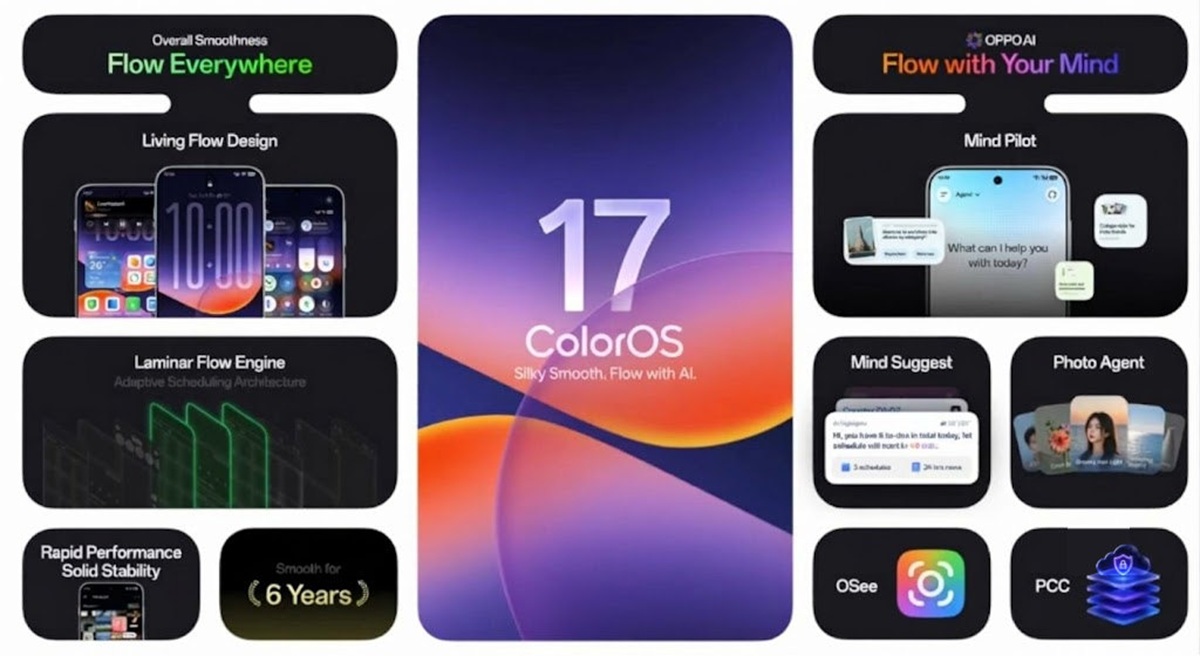
OPPO AI | AI Mind Pilot Introduces Agent Mode
ColorOS 17 expands OPPO AI with system-level agentic capabilities designed to complete multi-step tasks. The features can work with device content, search across multiple sources, use relevant tools, and coordinate actions according to the user’s request.
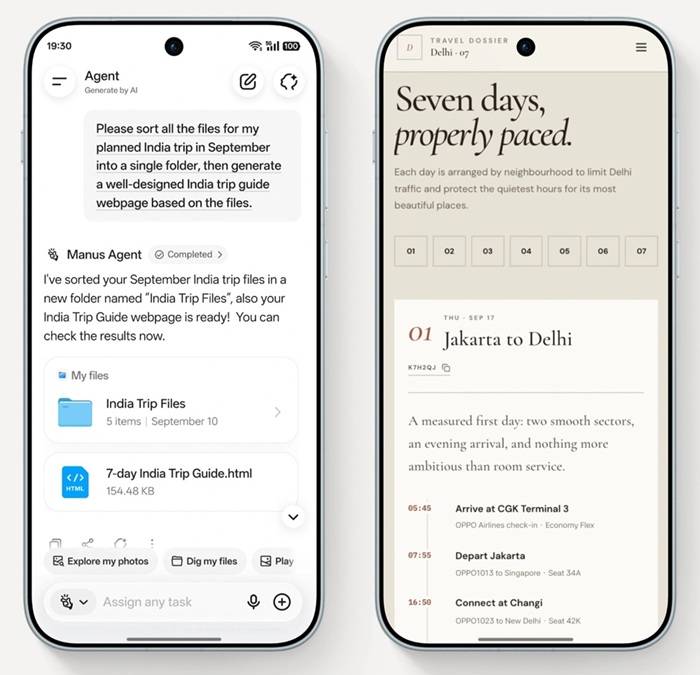
AI Mind Pilot introduces Agent Mode, which works directly with photos and files stored on the device. It can locate scattered files, organize them, rename them according to their content and date, and use the information within them to create outputs such as travel itineraries and webpages.
The feature can also locate photos from a particular trip, arrange them into albums, and adapt selected images for creative uses, including vlog covers. These capabilities are intended to reduce the manual effort involved in managing files and completing workflows across multiple steps.
AI Photo Agent | Style Match for Personalized Editing
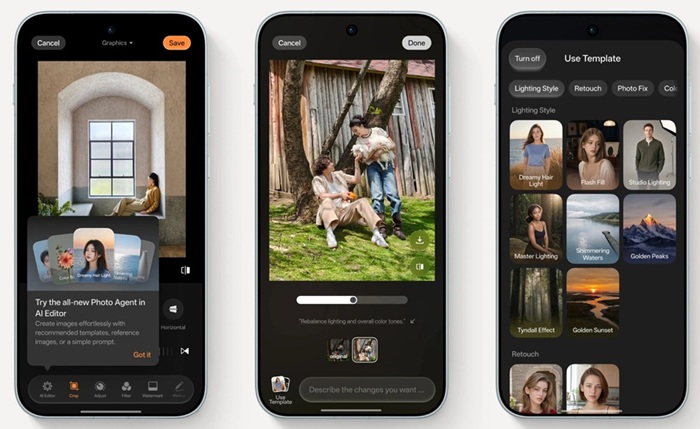
The new AI Photo Agent brings natural-language editing and contextual recommendations to photo editing. Users can describe the changes they want, while the AI can also analyze a photo’s scene and subject to suggest suitable adjustments.
Its Style Match feature analyzes a reference image’s color palette, tone, and overall mood before applying a similar look to the user’s photo. Users can also choose built-in templates, use editing suggestions as a starting point, and describe their preferred changes through prompts.
OPPO says the feature is designed to make editing more intuitive while preserving the original scene’s natural appearance and character.
AI Mind Space | Memory Collections | Personalized Travel Planning
AI Mind Space, OPPO’s personal information hub, can save documents and video links and convert their contents into structured, searchable personal memories.
ColorOS 17 adds Memory Collections, which automatically groups related information into collections and summaries as the user’s saved content grows. For travel planning, AI Mind Space can combine saved information with destination maps to create personalized trip plans based on collected places, ideas, and details.
The feature aims to make previously saved information easier to retrieve and reuse instead of leaving it scattered across documents and links.
AI Mind Suggest | Contextual Information and Services
AI Mind Suggest surfaces relevant information and services throughout the day. Its capabilities include morning briefs, travel reminders, and flight and train cards containing important journey information. It can also recommend music when headphones are connected.
By bringing relevant information forward when it may be useful, the feature is designed to reduce the need to search manually through applications for updates and reminders.
OSee | Visual AI for Recognition, Translation, and Scanning
OSee brings OPPO’s visual AI capabilities into a single experience. Using the camera, it can recognize objects and scenes and connect users with relevant services without requiring them to select separate tools.
Supported functions include object recognition, knowledge lookup, nutrition analysis, high-definition scanning, and translation. The feature is designed to make camera-based AI assistance more accessible during everyday activities.
Private Computing Cloud | Post-Quantum Security | Transparency Report
ColorOS 17 introduces additional privacy protections for AI-powered workflows. Private Computing Cloud (PCC) uses end-to-end encryption for cloud-based AI processing, with a secure environment designed to prevent access by third parties, including OPPO itself.
The update also adds a dual-encryption mechanism with post-quantum security capabilities to help protect information transmitted between devices and the cloud against emerging threats associated with quantum computing.
A new Transparency Report lets users review which AI services have been used, when they were accessed, and what operations were performed. Users can view the report on their devices and export it when needed.
AI Call Guard | Synthetic Voice Recognition | AI Face Swap Detection
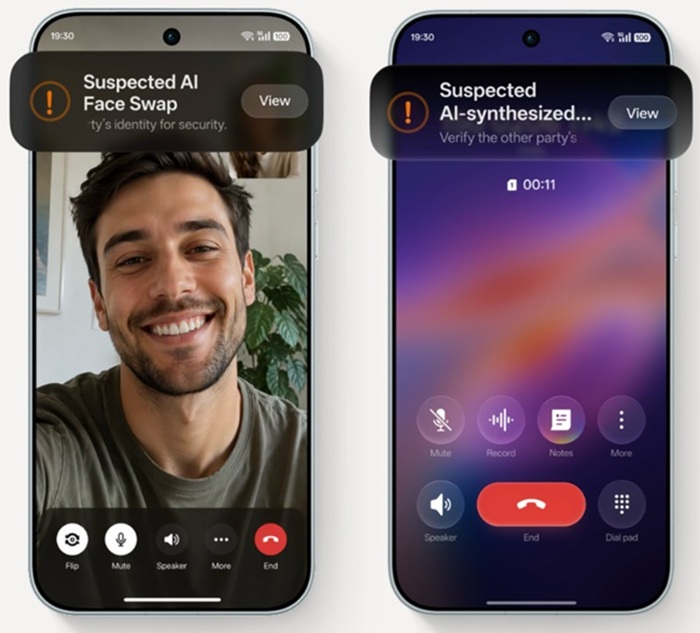
ColorOS 17 introduces AI Call Guard, an on-device AI feature that monitors calls in real time for potential fraud risks and alerts users when suspicious activity is detected.
Its security capabilities include:
- AI Face Swap Detection: Helps identify manipulated faces in videos.
- Synthetic Voice Recognition: Detects AI-generated voices during phone calls and WhatsApp calls.
- Enhanced Protection Mode: Provides a simplified interface with larger visuals and clearer audio, alongside additional protection against scams.
These features are designed to strengthen protection against emerging forms of communication fraud.
AI Live Interpreter | Real-Time Translation Through Earbuds
ColorOS 17 also introduces AI Live Interpreter, which translates conversations through compatible earbuds to support communication between people speaking different languages. It uses speaker recognition to help distinguish participants during conversations.
The feature is designed to make face-to-face multilingual communication more convenient without requiring speakers to repeatedly pass a phone between them.
OPPO ColorOS 17 Global Rollout Timeline
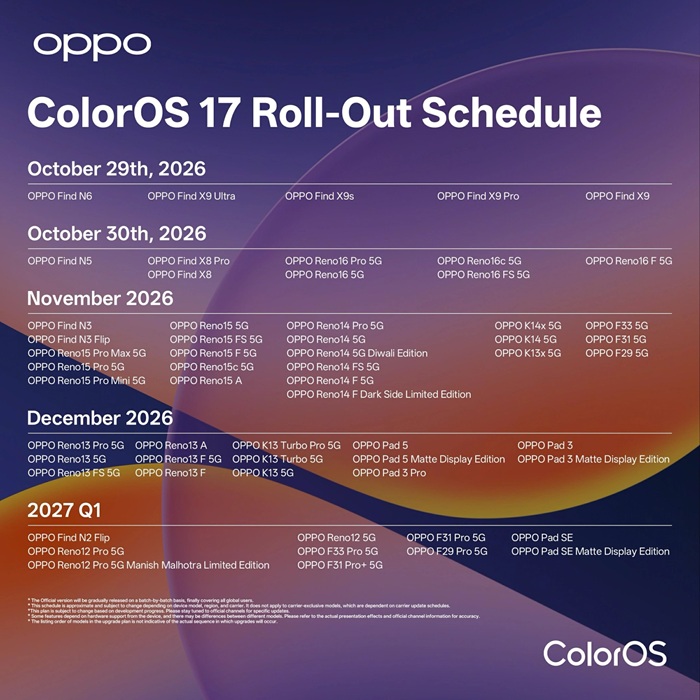
ColorOS 17 will debut on the upcoming OPPO Find X10 Series, followed by a phased rollout to additional OPPO devices worldwide.
| Rollout Date | Eligible OPPO Devices |
|---|---|
| 29th October 2026 | OPPO Find N6, Find X9 Ultra, Find X9s, Find X9 Pro, Find X9 |
| 30th October 2026 | OPPO Find N5, Find X8 Pro, Find X8, Reno16 Pro 5G, Reno16 5G, Reno16c 5G, Reno16 FS 5G, Reno16 F 5G |
| November 2026 | OPPO Find N3, Find N3 Flip, Reno15 Pro Max 5G, Reno15 Pro 5G, Reno15 Pro Mini 5G, Reno15 5G, Reno15 FS 5G, Reno15 F 5G, Reno15c 5G, Reno15 A, Reno14 Pro 5G, Reno14 5G, Reno14 5G Diwali Edition, Reno14 FS 5G, Reno14 F 5G, Reno14 F Dark Side Limited Edition, K14x 5G, K14 5G, K13x 5G, F33 5G, F31 5G, F29 5G |
| December 2026 | OPPO Reno13 Pro 5G, Reno13 5G, Reno13 FS 5G, Reno13 A, Reno13 F 5G, Reno13 F, K13 Turbo Pro 5G, K13 Turbo 5G, K13 5G, Pad 5, Pad 5 Matte Display Edition, Pad 3 Pro, Pad 3, Pad 3 Matte Display Edition |
| Q1 2027 | OPPO Find N2 Flip, Reno12 Pro 5G, Reno12 Pro 5G Manish Malhotra Limited Edition, Reno12 5G, F33 Pro 5G, F31 Pro+ 5G, F31 Pro 5G, F29 Pro 5G, Pad SE, Pad SE Matte Display Edition |
Note: The performance figures and six-year smoothness claim are based on OPPO’s reported testing. Actual results may vary by device and usage conditions.

Important Rollout Notes:
- The official version will be gradually released in batches, eventually covering global users.
- The schedule is approximate and may change depending on the device model, region, and carrier.
- Carrier-exclusive models may follow separate carrier update schedules.
- The plan is subject to change as development progresses.
- Users should check official OPPO channels for device-specific updates.
- Some features may depend on hardware support and can differ between models.